
 Chaotic chatter
of children reverberating off every wall leads me up the steep spiral
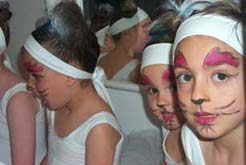
stairs. There I find 79 dance students painstakingly made up and dressed
as cats, their hair pulled back to resemble ears. Moms paint final touches
on their cherubs' faces while Benilde Marini, the choreographer and director
of Movemiento e Fantasia Centro Danza, scurries from dressing room to
dressing room. The show is about to begin, and I am expected to take photos.
I want to capture the boundless energy that prevails backstage, but I
need to remain unobtrusive.
Chaotic chatter
of children reverberating off every wall leads me up the steep spiral
stairs. There I find 79 dance students painstakingly made up and dressed
as cats, their hair pulled back to resemble ears. Moms paint final touches
on their cherubs' faces while Benilde Marini, the choreographer and director
of Movemiento e Fantasia Centro Danza, scurries from dressing room to
dressing room. The show is about to begin, and I am expected to take photos.
I want to capture the boundless energy that prevails backstage, but I
need to remain unobtrusive.
Armed with my
digital camera, I am caught up in the rush of nervous cats and carried
along backstage into the wings. A stampede of dancers dash down the steps
and surround me in a flurry of commotion, none of which I can translate.
I tiptoe around each ballerina, trying to remain unnoticed. My attempt
is futile.
Surrounded
by perfect lighting, I shoot a picture of an older student who is dressed
in a crimson leotard. Even though there is no flash, she immediately speaks
to me in terrifying, rapid Italian. I can only shake my head. She repeats
herself once more.
"Io non parlo
Italiano," I stutter. Frustrated, she grabs my right arm, glances at my
watch, nods her painted face, and leaves as fast as she entered.
What is it like
to be the photographer backstage?
It is terrifying.
And exhilarating.
Two nights before
the performance, the technology manager had asked me to do the project
at the Teatro Comunale. He overheard that I was going to photograph
the performance and instantly gave me backstage access. So here I am,
with one
"I'm just a
student," I insisted. But before anybody could convince him otherwise,
I was thrust into the middle of backstage jitters.
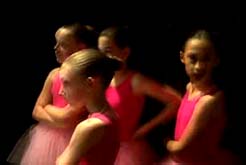
Through the
lens of my camera, I watch the dancers interact. The youngest girls are
dressed in white like angelic kittens, whispering and pointing to the
older cats they admire on stage. Girls in pink mask their anxiety in the
dim light and are too preoccupied to smile for a photo op. With an extended
exposure, I snap their picture before they are whisked on stage by the
tempo of their music.
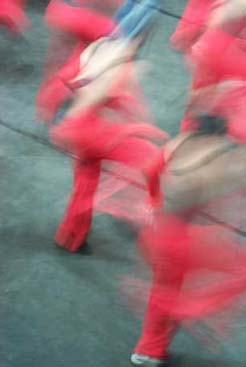
Each dancer,
even moving only slightly, is dramatic, but the constant movement is also
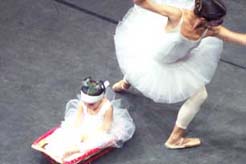
the source of my frustration. Only the small ones who sit in the corner
allow me enough time to shoot several satisfying pictures. Large groups
of giddy dancers rush into my space and stifle opportunities like lions
on the prowl. Time and time again I position myself hoping to capture
a perfect moment, and when the moment arrives, a dancer rushes past, inevitably
clouding my field of view.
Although the
experience is not the easiest, the lighting is brilliant from where I
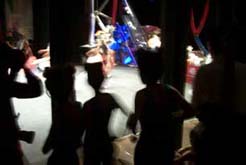
stand. Silhouettes are pronounced and the low light creates dream-like
effects. The dancers are seemingly on stage for me alone, not the audience,
and backstage is certainly a performance in itself. In the dark wings
I witness encouragement, adrenaline rushes, and high-fives after well-performed
numbers. To me it is like an opera-I don't understand the words, yet the
music and the movements of the dancers are a language of their own, and
I am a part of it.
HTML: Liz Iasiello
June 2002